VAT relief on a walk-in shower, wet room or adapted bathroom
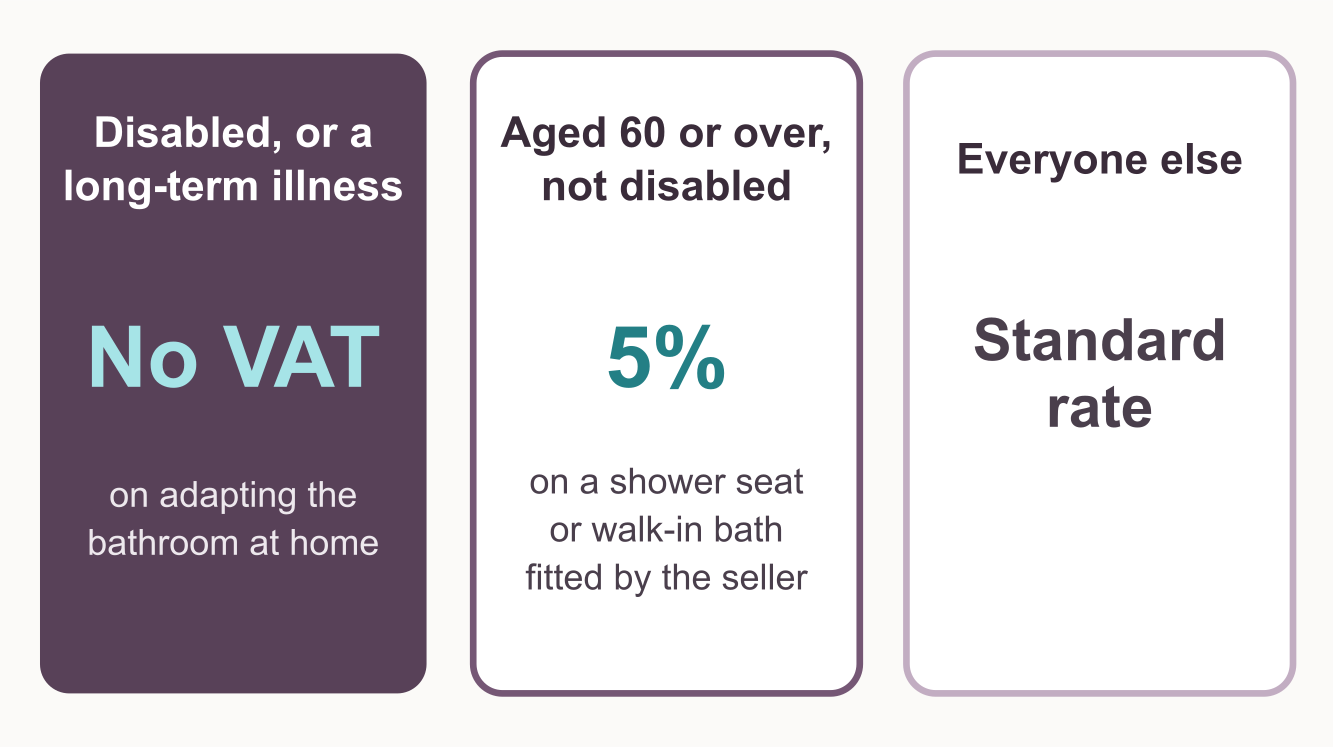
If you are disabled or have a long-term illness, no VAT is charged on providing or adapting a bathroom, washroom or lavatory in your own home, and a bathroom includes a shower or wet room (GOV.UK, checked 12 November 2026). The relief is not means-tested and needs no application: the firm applies it when you give a written declaration. If you are aged 60 or over and not disabled, a few fitted items carry a reduced 5% rate instead. Everyone else pays the standard rate.
Data last reviewed: 13 November 2026. Each figure below has its source and the date it was checked beside it.
What the zero rate covers
HMRC’s notice on VAT reliefs for disabled and older people lets a firm zero rate the work of providing, extending or adapting a bathroom, washroom or lavatory, as long as the work is necessary to suit the condition of a disabled person and the building is their private residence. For this relief, a bathroom includes a shower or wet room (GOV.UK, checked 12 November 2026). The notice also covers:
- The work that makes it possible. Other work essential to the bathroom, such as installing porcelain goods, work to provide water, gas, electricity and drainage, and restoring the immediate decor, including retiling (HMRC Notice 701/7, checked 13 November 2026).
- The materials. Building materials the firm supplies as part of that work (HMRC Notice 701/7, checked 13 November 2026).
- Space taken from another room. If the new bathroom makes another room smaller, restoring that lost space, and only that, can be zero-rated too (HMRC Notice 701/7, checked 13 November 2026).
- Some equipment in its own right. Commode chairs, devices with a warm air drier and bidet jet, and frames to help sitting on or rising from a toilet, and plumbing them in (HMRC Notice 701/7, checked 13 November 2026). More on disabled toilet grants.
What it does not cover
The zero rate stops at the bathroom. It does not cover adapting bedrooms, kitchens or other rooms, even for a disabled person. An architect’s or surveyor’s separate fees are standard-rated unless they are part of a single design and build contract. Later repairs are not covered either: retiling a bathroom that was first fitted at the zero rate carries VAT, although repairing or replacing an eligible sanitary device does not (HMRC Notice 701/7, checked 13 November 2026). Materials you buy for a friend or relative to fit for nothing, or for your own DIY, are not eligible (HMRC Notice 701/7, checked 13 November 2026).
Who qualifies
The relief is not means-tested, does not depend on benefits, and you do not need to be registered disabled. HMRC treats a person as chronically sick or disabled if they have a physical or mental impairment with a long-term and substantial adverse effect on their ability to carry out everyday activities, or a condition the medical profession treats as a chronic sickness, such as diabetes. It does not include an elderly person who is not disabled or chronically sick, or someone only temporarily disabled, such as with a broken limb (HMRC Notice 701/7, checked 13 November 2026). GOV.UK puts the same line plainly (GOV.UK, checked 12 November 2026).
The declaration
HMRC issues no certificate. Instead, you give the firm a written declaration that you qualify. It should be separate from the order form or invoice, so that signing an order does not sign the declaration by accident. If the disabled person cannot sign, for example because they are a child or cannot write, a parent, guardian, doctor or another responsible person can sign for them (HMRC Notice 701/7, checked 13 November 2026). The firm decides whether to zero rate and keeps the declaration; HMRC cannot say whether a particular person qualifies. If VAT is charged wrongly, the firm corrects it and refunds you, because HMRC cannot refund customers directly.
The reduced rate for people aged 60 or over
A person aged 60 or over who is not disabled pays VAT at 5%, rather than the standard rate, on a short list of items: grab rails, ramps, stair lifts, bath lifts, built-in shower seats or showers containing them, and walk-in baths with sealable doors (HMRC Notice 701/7, checked 12 November 2026). Three conditions apply. The same firm must supply and install the item. It must go into a private home, your own or one shared with friends or relations, not a residential home. And it does not extend to general adaptations, such as a whole new bathroom (HMRC Notice 701/7, checked 13 November 2026). Someone else, including a relative, a charity or a council, can order and pay. More on grants for older people.
When a council grant pays for the work
The relief still applies when the council pays through a Disabled Facilities Grant. HMRC’s notice says the council may pay the grant to the disabled person or to the contractor, and that where it pays the contractor, the invoice should state that the work was done for the disabled person the grant was awarded to (HMRC Notice 701/7, checked 13 November 2026). The government’s guidance tells councils that most adaptation work is zero-rated, and that where VAT is properly charged at the standard rate, it is included in the estimate the grant is worked out on (government guidance to councils, checked 13 November 2026). See disabled bathroom grants for the grant itself.
Checking a quote
A quote for bathroom work should show VAT on its own line and say which rate it has used: none, 5% on listed items, or the standard rate. If you qualify for the zero rate and a quote charges VAT on the whole job, ask why. Compare quotes on the same basis using the figures on walk-in shower cost, wet room cost and replacing a bath, and see help with the cost for the other routes.
Questions about VAT on bathroom work
For a disabled person, or someone with a long-term illness, in their own home: yes. HMRC lets a firm zero rate the work of providing, extending or adapting a bathroom, washroom or lavatory when it is needed because of the person’s condition, and a bathroom includes a shower or wet room.
No. HMRC issues no certificate. You give the firm a signed written declaration that you qualify, separate from the order form or invoice, and the firm keeps it. A parent, guardian, doctor or another responsible person can sign if you cannot.
Ask the firm. HMRC cannot refund you directly; a firm that charged VAT wrongly corrects its records and refunds you.
Sources for this page
Every figure and rule above comes from one of these pages. Data last reviewed: 13 November 2026. If one of them has changed since, tell us and we will check it.
- GOV.UK, VAT relief for disabled people (read 12 November 2026)
- HMRC, Reliefs from VAT for disabled and older people (VAT Notice 701/7), last updated 31 December 2020 (read 13 November 2026)
- Disabled Facilities Grant (DFG) delivery: guidance for local authorities in England (gov.uk, 28 March 2022) (read 13 November 2026)