Replace bath with walk in shower: what it costs and who can help pay
To replace a bath with a walk in shower, the bath comes out and a shower you can step or wheel into goes in its place. Research for the Centre for Ageing Better puts the typical cost of a shower replacing a bath at £4,847 at 2019/20 prices (BRE for the Centre for Ageing Better, checked 13 November 2026), close to the £4,755 average the government’s 2018 review found for grant-funded level access showers in England (2018 government review, checked 13 November 2026).
Paying privately is likely to cost more than these council prices. A council grant can pay instead when the work is needed, and a disabled person pays no VAT on it.
Data last reviewed: 13 November 2026. Each figure below has its source and the date it was checked beside it.
Get a quote to replace your bath
Tell us which job you are pricing and the postcode of the home. Your details come to SEO Dons Ltd, which runs Walk-in Shower Grants, and we reply by email. You don't have to buy anything.
What happens next
- Your details arrive with SEO Dons Ltd, the company that runs this site.
- We read what you have asked about and reply by email.
- A quote ties you to nothing. If you want the council to consider a grant, wait for its approval before you order.
What the job involves
Taking out a bath sounds simple, and the bath is the easy part. The work is in what replaces it. A typical job runs in this order: the bath, its panel and the tiles around it come out; the pipes are moved for the new shower; the floor is prepared, either for a low tray or for a level floor that slopes gently to a drain; the floor and walls are waterproofed; the drain goes in; the walls are tiled or panelled; then the screen, the shower, any seat and rails, and the finishing.
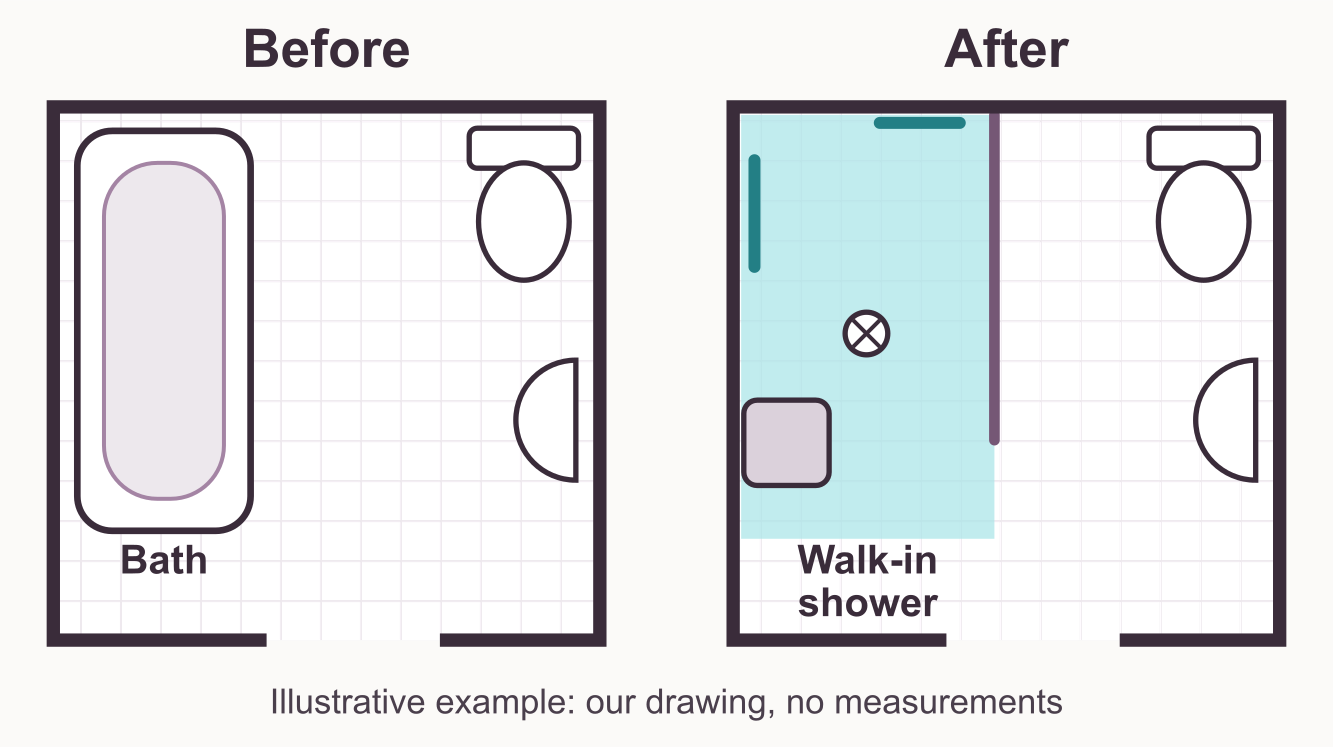
Where the shower takes the bath’s footprint, the toilet and basin can stay put, which keeps the cost down. Moving them, widening the door or changing the layout of the room turns it into a bigger job, closer to the figures on wet room cost.
What it costs: the published figures
Research on adaptations funded through councils gives the clearest comparison between the options for a bathroom.
| Option | Figure | What it is |
|---|---|---|
| Shower over the bath | £1,939 | BRE typical cost, 2019/20 prices. The bath stays, so the step over its side stays too. |
| Shower replacing a bath | £4,847 | BRE typical cost, 2019/20 prices. |
| Level access shower, grant-funded | £4,755 | Average in England, 2016/17, from the 2018 government review. |
| Level-access shower, unit cost | £4,798 | Median with fitting, 2019/20 prices, national unit costs. |
| Graduated floor shower | £6,558 | BRE typical cost, 2019/20 prices: a floor that falls to the drain. |
Sources: (BRE for the Centre for Ageing Better, checked 13 November 2026), (2018 government review, checked 13 November 2026), (Unit Costs of Health and Social Care 2020, checked 13 November 2026). None says whether VAT is included. BRE’s are older typical costs uprated for inflation.
For a newer, private view, Impey, a maker of shower floors, said in October 2026 that a low-profile tray with a simple enclosure can cost about £1,500 to £3,000 including labour, but that such trays often keep a small lip (Impey, checked 13 November 2026). Whichever figure you start from, the 2018 review’s warning holds: someone paying privately is likely to pay more than a council (2018 government review, checked 13 November 2026). Every published figure is on walk-in shower cost, and the cost calculator puts your own quote against the grant limit.
Tray or level floor?
This is the choice that matters most for someone who finds the bath hard. A low tray still has an edge, however small. A level access shower has none: the floor of the shower is level with the room, so you can walk in with a frame or wheel in with a shower chair. The grant guidance treats replacing a tray that has a step with a flush floor as an improvement, not a repair (government guidance to councils, checked 13 November 2026), which tells you which councils think meets the need. The difference is set out on what is a level access shower.
When the council can pay for it
A shower you can walk into is the most common job the Disabled Facilities Grant does: a level-access shower was 55% of grants approved in England in 2016/17 (2018 government review, checked 13 November 2026), and GOV.UK names the level access shower among its examples (GOV.UK, checked 12 November 2026). The council will still assess whether it is necessary and appropriate for the person and reasonable for the home (GOV.UK, checked 12 November 2026). One thing the guidance makes clear: it is a bath or a shower, not both, unless there is a medical need for both (government guidance to councils, checked 13 November 2026). If keeping a bath matters, read walk-in bath grants before the assessment.
In Scotland, the government’s guide for homeowners gives “replacing the bath with a shower” as its own example of a housing adaptation (Scottish Government, checked 13 November 2026). The limit or share in each nation is on grants by nation, and the bathroom route is on disabled bathroom grants. In England the limit is £30,000 (GOV.UK, checked 12 November 2026).
VAT when you replace the bath
If the person is disabled or has a long-term illness and the bathroom is in their own home, no VAT is charged on adapting it (GOV.UK, checked 12 November 2026). That includes the work needed to make it happen: plumbing, drainage, electrics and retiling (HMRC Notice 701/7, checked 13 November 2026). For someone aged 60 or over who is not disabled, the reduced 5% rate applies only to a built-in shower seat or a shower containing one, supplied and fitted by the same firm, not to the whole job (HMRC Notice 701/7, checked 13 November 2026). More on VAT relief.
If you are paying yourself
Get two written quotes that list the same work, line by line: removing the bath, the floor or tray, the waterproofing, the drain, the walls, the screen, the shower and its controls, any seat and rails, and making good. Ask how long you will be without a bath or shower, and what happens if the floor needs more work than expected. If you agree the job at home, a 14-day cancellation period applies, from when the goods arrive or, for services only, from the contract (legislation.gov.uk, checked 12 November 2026), but goods made to your specifications can fall outside it, and the firm must say so before you are bound (legislation.gov.uk, checked 12 November 2026). For every other way to bring the cost down, see help with the cost.
Questions about taking the bath out
Research for the Centre for Ageing Better puts the typical cost of a shower replacing a bath at £4,847 at 2019/20 prices, and the 2018 government review found grant-funded level access showers averaged £4,755 in England. Both are prices agreed for council work. A private quote is likely to be higher, and depends on the floor, the drain and how much of the room changes.
It can, through the Disabled Facilities Grant, if its assessment finds a shower necessary and appropriate for the disabled person and practical in the home. The guidance treats it as one or the other: someone who needs both a bath and a shower must show a medical need for both. Ask the council first, and wait for its approval before ordering anything.
Much cheaper, at a typical £1,939 against £4,847 in the same research, but you still have to step over the side of the bath. For anyone who struggles with that step, it does not solve the problem a walk-in shower solves.
Sources for this page
Every figure and rule above comes from one of these pages. Data last reviewed: 13 November 2026. If one of them has changed since, tell us and we will check it.
- BRE, National Evaluation of Home Improvement Services: BRE supporting research (Centre for Ageing Better, February 2025), Table 16 (read 13 November 2026)
- Disabled Facilities Grant (DFG) and Other Adaptations: External Review, main report (for the government, December 2018), Table 5.1 (read 13 November 2026)
- Unit Costs of Health and Social Care 2020 (PSSRU, University of Kent), section 7.3, Tables 1 and 4 (read 13 November 2026)
- Impey, How much does a wetroom cost in 2026? (impeyshowers.com, 21 October 2026) (read 13 November 2026)
- Disabled Facilities Grant (DFG) delivery: guidance for local authorities in England (gov.uk, 28 March 2022) (read 13 November 2026)
- GOV.UK, Disabled Facilities Grants: eligibility (read 12 November 2026)
- GOV.UK, Disabled Facilities Grants: overview (read 12 November 2026)
- GOV.UK, Disabled Facilities Grants: what you’ll get (read 12 November 2026)
- Scottish Government, Funding adaptations to the home: a guide for homeowners (gov.scot, 9 May 2011) (read 13 November 2026)
- GOV.UK, VAT relief for disabled people (read 12 November 2026)
- HMRC, Reliefs from VAT for disabled and older people (VAT Notice 701/7), last updated 31 December 2020 (read 13 November 2026)
- Consumer Contracts (Information, Cancellation and Additional Charges) Regulations 2013, regulation 30 (legislation.gov.uk) (read 12 November 2026)
- Consumer Contracts (Information, Cancellation and Additional Charges) Regulations 2013, regulation 28 (legislation.gov.uk) (read 12 November 2026)