Can I get help with a walk in shower? Every route, and who it is for
Yes, if the person is disabled you can get help with a walk in shower in at least one way. The main route is the council’s Disabled Facilities Grant, which names the level access shower among the things it can pay for (GOV.UK, checked 12 November 2026). If you are left with a share to pay, or the grant does not fit, the cost can still come down: no VAT for a disabled person, a lower rate for some older people, help from a landlord, a council top-up or loan, or a charity.
Data last reviewed: 13 November 2026. Each figure below has its source and the date it was checked beside it.
Get a quote for your walk-in shower
Tell us which job you are pricing and the postcode of the home. Your details come to SEO Dons Ltd, which runs Walk-in Shower Grants, and we reply by email. You don't have to buy anything.
What happens next
- Your details arrive with SEO Dons Ltd, the company that runs this site.
- We read what you have asked about and reply by email.
- A quote ties you to nothing. If you want the council to consider a grant, wait for its approval before you order.
The routes at a glance
| Route | Who it is for | What it can cover | Where to start |
|---|---|---|---|
| Disabled Facilities Grant | A disabled person, whether they own, rent or let the home | Up to £30,000 in England; Wales, Scotland and Northern Ireland differ | Your council; the health trust in Northern Ireland |
| Minor adaptations (England) | An adult the council has assessed as having care needs | Small changes costing £1,000 or less, with no charge | Your council’s adult social care team |
| No VAT on the work | A disabled person or someone with a long-term illness, at any income | Providing or adapting a bathroom at home | The firm, with your written declaration |
| Reduced VAT at 5% | Aged 60 or over and not disabled | A built-in shower seat, or a shower containing one, supplied and fitted by one firm | The firm, with your written declaration |
| Council top-up or loan | Depends on the council’s own policy | The share the grant leaves, or costs over the limit | Your council’s housing assistance policy |
| Your landlord | Council, housing association and private tenants | Adaptations to a home you rent | Your landlord, then the council |
| Charities | People in financial need, through a professional or adviser | Gaps that public help leaves | A grants search, or your occupational therapist |
Sources for each row are in the sections below and in the list at the foot of the page.
Start with the council’s grant
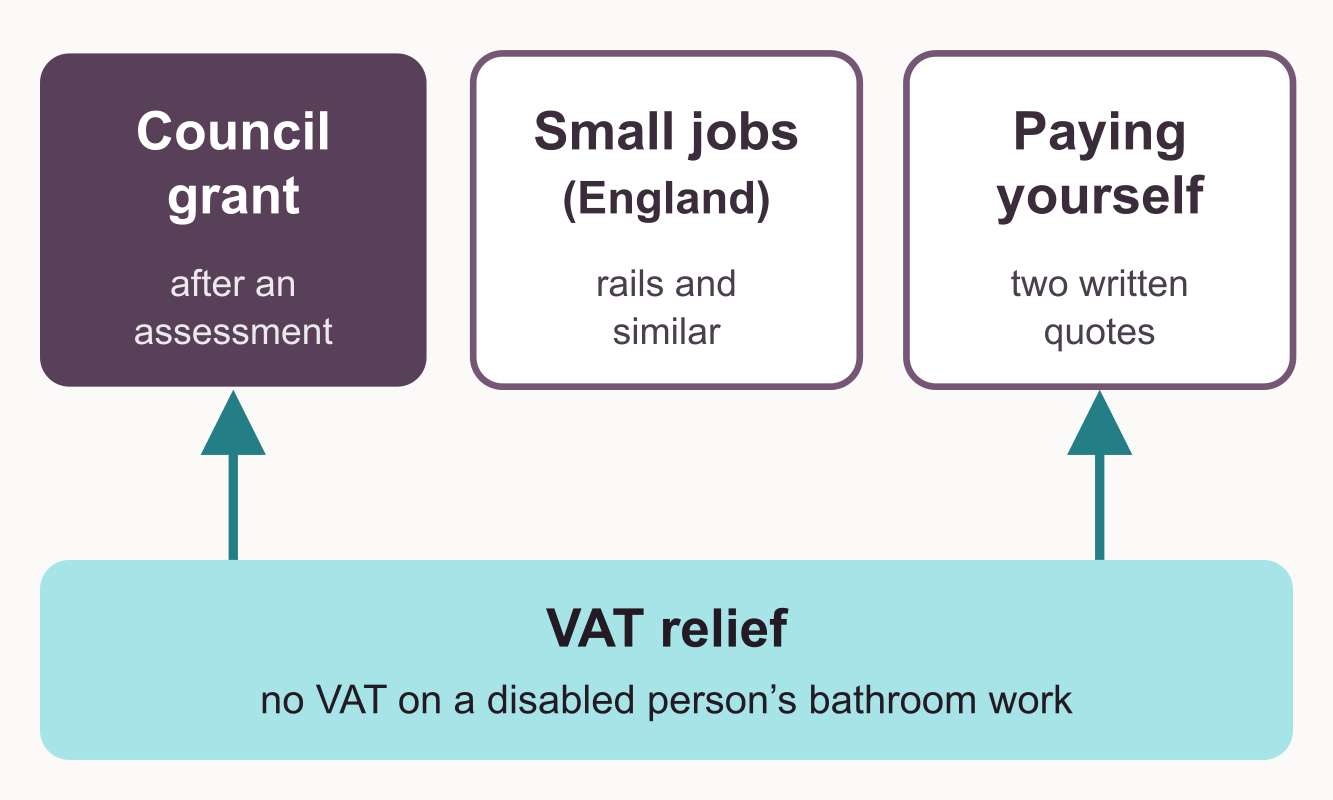
The Disabled Facilities Grant is the route that can pay for the whole job. A level access shower is one of GOV.UK’s own examples of what it covers, and the most a council has to pay in England is £30,000 (GOV.UK, checked 12 November 2026). In England the amount usually depends on income and on savings over £6,000 (GOV.UK, checked 12 November 2026), but someone who already gets Universal Credit, Housing Benefit, Income Support, income-based Jobseeker’s Allowance or income-related Employment and Support Allowance, or the guarantee part of Pension Credit, is treated as having nothing to pay (government guidance to councils, checked 12 November 2026).
Wales is more generous for this job. A walk-in shower is a “medium” adaptation (Welsh Government, checked 12 November 2026), and most Welsh councils no longer means-test small and medium grants (Welsh Government, checked 12 November 2026). Scotland has no Disabled Facilities Grant: a council that finds the work essential pays at least 80% of the approved cost, and all of it for people on certain benefits (legislation.gov.uk, checked 12 November 2026). The full picture for a bathroom is on disabled bathroom grants, and what councils actually fit is on council disabled showers. Each nation’s rules, side by side, are on grants by nation.
If the grant leaves you a share to pay
A contribution under the means test is not the end of the road. The government’s guidance to English councils says they can top up grants and offer loans under their own policies, for example to help people who have a contribution to pay (government guidance to councils, checked 13 November 2026), and that where someone struggles to meet their contribution, the social care authority can step in (government guidance to councils, checked 13 November 2026). Some councils go further for showers. Spelthorne Borough Council, for one, had a local policy of not means-testing level access showers; its officers proposed ending it in May 2026, citing an average cost of £7,918 per shower (Spelthorne Borough Council, checked 13 November 2026). Policies like that change, so ask your own council for its current housing assistance policy.
VAT: the help that needs no application
If the person is disabled or has a long-term illness, no VAT is charged on providing or adapting a bathroom in their own home, and a bathroom includes a shower or wet room (GOV.UK, checked 12 November 2026). It does not depend on income or benefits, and the person does not need to be registered disabled (HMRC Notice 701/7, checked 13 November 2026). The firm applies it when you give a written declaration. If you are aged 60 or over and not disabled, the reduced 5% rate covers a built-in shower seat or a shower containing one, but only when the same firm supplies and fits it (HMRC Notice 701/7, checked 13 November 2026). The detail is on VAT relief and, for older readers, grants for older people.
Small jobs in England
A council must not charge for minor adaptations it provides to meet an adult’s assessed care needs, and an adaptation counts as minor if it costs £1,000 or less (legislation.gov.uk, checked 12 November 2026). Rails by the bath or toilet can come this way. A whole walk-in shower costs more than that line, so it is grant territory: the NHS website points to the Disabled Facilities Grant for expensive adaptations such as a wet room (NHS website, checked 13 November 2026).
If you rent your home
- Private tenants can apply for the grant themselves; the owner, a tenant or a landlord can make the application (GOV.UK, checked 12 November 2026). You will normally need your landlord’s agreement.
- Council tenants can apply like anyone else, but councils are expected to pay for adaptations to their own homes from their housing budget (government guidance to councils, checked 13 November 2026), so start with the council as your landlord.
- Housing association tenants in Wales have a Physical Adaptations Grant through their landlord (Welsh Government, checked 12 November 2026).
- In Northern Ireland the Housing Executive’s grant is for owner occupiers, landlords and private tenants (nidirect, checked 13 November 2026). If you rent from the Housing Executive or a housing association, ask your landlord (nidirect, checked 13 November 2026).
Charities and other help
Some charities can fill a gap that public help leaves. Independence at Home gives grants towards specialist equipment and home adaptations for people with a long-term illness or disability who are in financial need, and only accepts applications from a health or social care professional or an adviser acting for you (Independence at Home, checked 13 November 2026). Turn2us, a national charity, runs a Grants Search that it says connects people to over 1,700 UK organisations offering grants (Turn2us, checked 13 November 2026). Keep the council’s letters: a fund may ask what other help you have applied for. In Wales, the Rapid Response Adaptations Programme makes quick small changes such as rails on a professional’s referral (Welsh Government, checked 12 November 2026).
Paying for it yourself
If you pay yourself, the price is the biggest lever. Grant-funded showers cost councils less than a private buyer is likely to pay (2018 government review, checked 13 November 2026), so get two written quotes for the same work and compare them line by line. See walk-in shower cost, wet room cost or replacing a bath with a walk-in shower for the published figures, and the cost calculator to set your own quote against the grant limit. This site gives no advice on borrowing, and names no lender.
More questions about help with the cost
Savings do not rule you out. In England the council grant usually depends on income and on savings over £6,000, so savings may mean you pay a share rather than being refused outright. VAT relief for a disabled person does not depend on savings at all. In most Welsh councils a walk-in shower is not means-tested.
Some charities give grants towards adaptations, and some accept applications only through a professional such as an occupational therapist or social worker. A grants search, such as the one Turn2us runs, is a quick way to see which ones might fit your circumstances.
Yes. Tenants can apply for the council grant with their landlord’s agreement. Council tenants should start with the council as their landlord, and in Wales housing association tenants have their own adaptations grant through the landlord.
Sources for this page
Every figure and rule above comes from one of these pages. Data last reviewed: 13 November 2026. If one of them has changed since, tell us and we will check it.
- GOV.UK, Disabled Facilities Grants: overview (read 12 November 2026)
- GOV.UK, Disabled Facilities Grants: what you’ll get (read 12 November 2026)
- Disabled Facilities Grant (DFG) delivery: guidance for local authorities in England (gov.uk, 28 March 2022) (read 13 November 2026)
- Welsh Government, written statement on removing the means test for small and medium grants (gov.wales) (read 12 November 2026)
- Welsh Government, ENABLE: support for living independently (gov.wales) (read 12 November 2026)
- Welsh Government, Adapt your home if you are disabled or an older person (gov.wales) (read 12 November 2026)
- Spelthorne Borough Council, Community Wellbeing and Housing Committee, 2 June 2026: Review of Disabled Facilities Grant Policy (supplementary agenda dated 27 May 2026) (read 13 November 2026)
- GOV.UK, VAT relief for disabled people (read 12 November 2026)
- HMRC, Reliefs from VAT for disabled and older people (VAT Notice 701/7), last updated 31 December 2020 (read 13 November 2026)
- Care and Support (Charging and Assessment of Resources) Regulations 2014, regulation 3 (legislation.gov.uk) (read 12 November 2026)
- NHS, Home adaptations (nhs.uk, page last reviewed 12 December 2025) (read 13 November 2026)
- GOV.UK, Disabled Facilities Grants: eligibility (read 12 November 2026)
- nidirect, Disabled Facilities Grants (read 13 November 2026)
- nidirect, Adapting your home (nidirect.gov.uk) (read 13 November 2026)
- Scheme of Assistance Regulations 2008 (SSI 2008/406), regulations 3 and 4, as amended in 2013 (legislation.gov.uk) (read 12 November 2026)
- Independence at Home (independenceathome.org.uk) (read 13 November 2026)
- Turn2us, Apply for grants (turn2us.org.uk) (read 13 November 2026)
- Disabled Facilities Grant (DFG) and Other Adaptations: External Review, main report (for the government, December 2018), para 16.86 (read 13 November 2026)