Grant for a walk in shower in England, Scotland, Wales and Northern Ireland
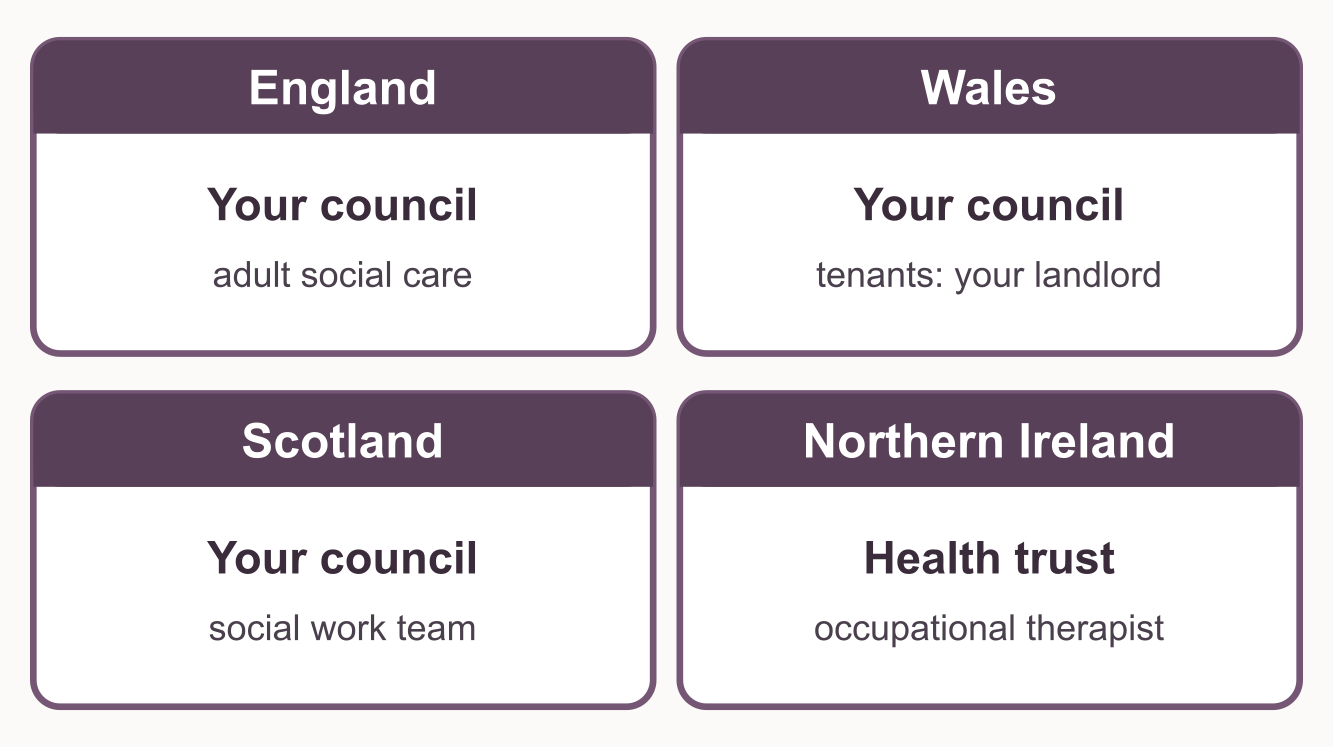
The grant for a walk in shower works differently in each part of the UK. England and Wales have the council’s Disabled Facilities Grant, up to £30,000 and £36,000. Northern Ireland has the Housing Executive’s version, up to £35,000 on a low income. Scotland has no Disabled Facilities Grant at all: councils pay at least 80% of the approved cost of essential adaptations instead. Who you contact first differs too.
Data last reviewed: 13 November 2026. Each figure below has its source and the date it was checked beside it.
| Nation | The grant | Most it has to pay | Means test for a shower | Contact first |
|---|---|---|---|---|
| England | Disabled Facilities Grant | £30,000 | Usually | Council adult social care |
| Wales | Disabled Facilities Grant | £36,000 | Not in most councils | Council; tenants their landlord |
| Scotland | Scheme of Assistance grant | At least 80% of the approved cost | The share depends on benefits | Council social work team |
| Northern Ireland | Disabled Facilities Grant (Housing Executive) | £35,000 | Yes | Your local health trust |
Sources for each row are in the sections below.
England
In England a grant for a walk-in shower comes through the council’s Disabled Facilities Grant, which pays up to £30,000; some councils may give more (GOV.UK, checked 12 November 2026). The amount usually depends on income and on savings over £6,000, but a disabled child under 18 is assessed without the parents’ income (GOV.UK, checked 12 November 2026), and anyone already getting benefits such as Universal Credit, Housing Benefit or Guaranteed Pension Credit has nothing to pay (government guidance to councils, checked 12 November 2026). Small changes such as rails come with no charge when they cost £1,000 or less and meet an adult’s assessed needs (legislation.gov.uk, checked 12 November 2026).
Two English points worth knowing before you start. Where an owner’s grant is over £5,000, a council may register a charge on the home, recoverable only if the home is sold within 10 years and never more than £10,000; councils must consider hardship and moves for health or care before asking for any of it back (government guidance to councils, checked 13 November 2026). And prices vary by region: the 2018 review found grant-funded showers averaged £3,617 in the North East and £5,911 in London (2018 government review, checked 13 November 2026). If you disagree with a decision, ask the council to review it, then complain to the Local Government and Social Care Ombudsman (GOV.UK, checked 12 November 2026).
Wales
Wales uses the same grant with a higher ceiling: up to £36,000, and a council may choose to pay more (legislation.gov.uk, checked 12 November 2026). The Welsh Government sorts adaptations into three sizes, and a walk-in shower is a medium one; moving a bathroom is a large one (Welsh Government, checked 12 November 2026). Since April 2021 most Welsh councils have not means-tested small and medium grants, but in 2023/24 and 2024/25 Caerphilly and Newport still did for medium adaptations (Welsh Government, checked 12 November 2026). So in most Welsh council areas a walk-in shower is not means-tested; check with your own council.
Home owners contact the council; tenants of a private landlord, the council or a housing association contact their landlord (Welsh Government, checked 13 November 2026). Wales also has the Rapid Response Adaptations Programme for quick small changes such as rails, on a professional’s referral, and a Physical Adaptations Grant for housing association tenants (Welsh Government, checked 12 November 2026). In 2020-21, a year hit by Covid, the median medium adaptation in Wales cost £3,840 and took 159 days to deliver (Welsh Government, checked 13 November 2026). Complaints go to the Public Services Ombudsman for Wales.
Scotland
Scotland has no Disabled Facilities Grant. Each council has a Scheme of Assistance instead. Where the council finds an adaptation essential and the work is structural or permanent, it must give a grant of at least 80% of the approved cost, and all of it for someone on Universal Credit, Income Support, income-based Jobseeker’s Allowance or income-related Employment and Support Allowance, or on the guarantee credit part of Pension Credit (legislation.gov.uk, checked 12 November 2026).
The Scottish Government’s guide for homeowners gives replacing the bath with a shower as an example of an adaptation, and says there is no upper limit on the cost of the work, though the council checks it is reasonable. Some councils top up the 80% grant, usually after a means test, and a case assessed as low priority may wait (Scottish Government, checked 13 November 2026). Equipment such as a shower chair is handled separately from the grant (Scottish Government, checked 13 November 2026). Start with your council’s social work team, which arranges the assessment.
Northern Ireland
In Northern Ireland the Housing Executive runs the Disabled Facilities Grant. Someone on a low income may get up to £35,000, rising to a maximum of £70,000 in some cases (nidirect, checked 13 November 2026). You may see a lower, older limit elsewhere, including in GOV.UK’s own table; nidirect’s figure is the one above. Only works recommended by your local occupational therapist can be considered for the grant, unless the local health trust and the Housing Executive agree otherwise, and nidirect’s list of typical work includes improving access to your bathroom and adding extra bathroom facilities (nidirect, checked 13 November 2026).
So the first call is to your local health trust, not the Housing Executive: the trust answers your questions, starts the process and contacts the Housing Executive. The grant is for owner occupiers, landlords and private tenants (nidirect, checked 13 November 2026); if you rent from the Housing Executive or a housing association, ask your landlord (nidirect, checked 13 November 2026). By law the Housing Executive must tell you in writing whether the application is approved or refused as soon as reasonably practicable, and no later than 6 months after the date of the application (legislation.gov.uk, checked 13 November 2026). You are paid once the work is finished and accepted by the occupational therapist and the Housing Executive (nidirect, checked 13 November 2026). Other work done at the same time is yours to pay for, and is not grant-aided (nidirect, checked 13 November 2026).
One rule everywhere
In every nation, ordering or starting the work before approval can cost you the grant: GOV.UK says you might not get any grant (GOV.UK, checked 12 November 2026), and in Northern Ireland nidirect says work must not start until you have the Housing Executive’s approval (nidirect, checked 13 November 2026). The steps are on how to apply, the bathroom detail on disabled bathroom grants, and the costs on walk-in shower cost.
Questions about the nations
Yes, but it is not called a Disabled Facilities Grant. If your council decides the adaptation is essential and the work is structural or permanent, it must pay at least 80% of the approved cost, and all of it if you get certain benefits. Start with the council’s social work team.
Not as a separate grant, but bathroom work an occupational therapist recommends can be considered for the Housing Executive’s Disabled Facilities Grant. nidirect’s list of typical work includes improving access to your bathroom and adding extra bathroom facilities, and someone on a low income may get up to £35,000. The route starts with your local health trust, not with the Housing Executive.
Usually not. A walk-in shower is a “medium” adaptation, and most Welsh councils no longer means-test small and medium grants. Two councils still did in recent years, so check with yours.
Sources for this page
Every figure and rule above comes from one of these pages. Data last reviewed: 13 November 2026. If one of them has changed since, tell us and we will check it.
- GOV.UK, Disabled Facilities Grants: what you’ll get (read 12 November 2026)
- Disabled Facilities Grant (DFG) delivery: guidance for local authorities in England (gov.uk, 28 March 2022) (read 13 November 2026)
- Care and Support (Charging and Assessment of Resources) Regulations 2014, regulation 3 (legislation.gov.uk) (read 12 November 2026)
- Disabled Facilities Grant (DFG) and Other Adaptations: External Review, main report (for the government, December 2018), Table 5.1 (read 13 November 2026)
- GOV.UK, consultation response on Disabled Facilities Grant allocations (17 February 2026) (read 12 November 2026)
- GOV.UK, Disabled Facilities Grants: how to apply (read 12 November 2026)
- Disabled Facilities Grants (Maximum Amounts and Additional Purposes) (Wales) Order 2008 (legislation.gov.uk) (read 12 November 2026)
- Welsh Government, ENABLE: support for living independently (gov.wales) (read 12 November 2026)
- Welsh Government, written statement on removing the means test for small and medium grants (gov.wales) (read 12 November 2026)
- Welsh Government, Adapt your home if you are disabled or an older person: how to apply (gov.wales) (read 13 November 2026)
- Welsh Government, Adapt your home if you are disabled or an older person (gov.wales) (read 12 November 2026)
- Welsh Government, High-level analysis of data on housing adaptations 2020-21 (July 2024) (read 13 November 2026)
- Scheme of Assistance Regulations 2008 (SSI 2008/406), regulations 3 and 4, as amended in 2013 (legislation.gov.uk) (read 12 November 2026)
- Scottish Government, Funding adaptations to the home: a guide for homeowners (gov.scot, 9 May 2011) (read 13 November 2026)
- nidirect, Disabled Facilities Grants (read 13 November 2026)
- nidirect, Adapting your home (nidirect.gov.uk) (read 13 November 2026)
- The Housing (Northern Ireland) Order 2003, article 65 (legislation.gov.uk) (read 13 November 2026)
- GOV.UK, Disabled Facilities Grants: eligibility (read 12 November 2026)